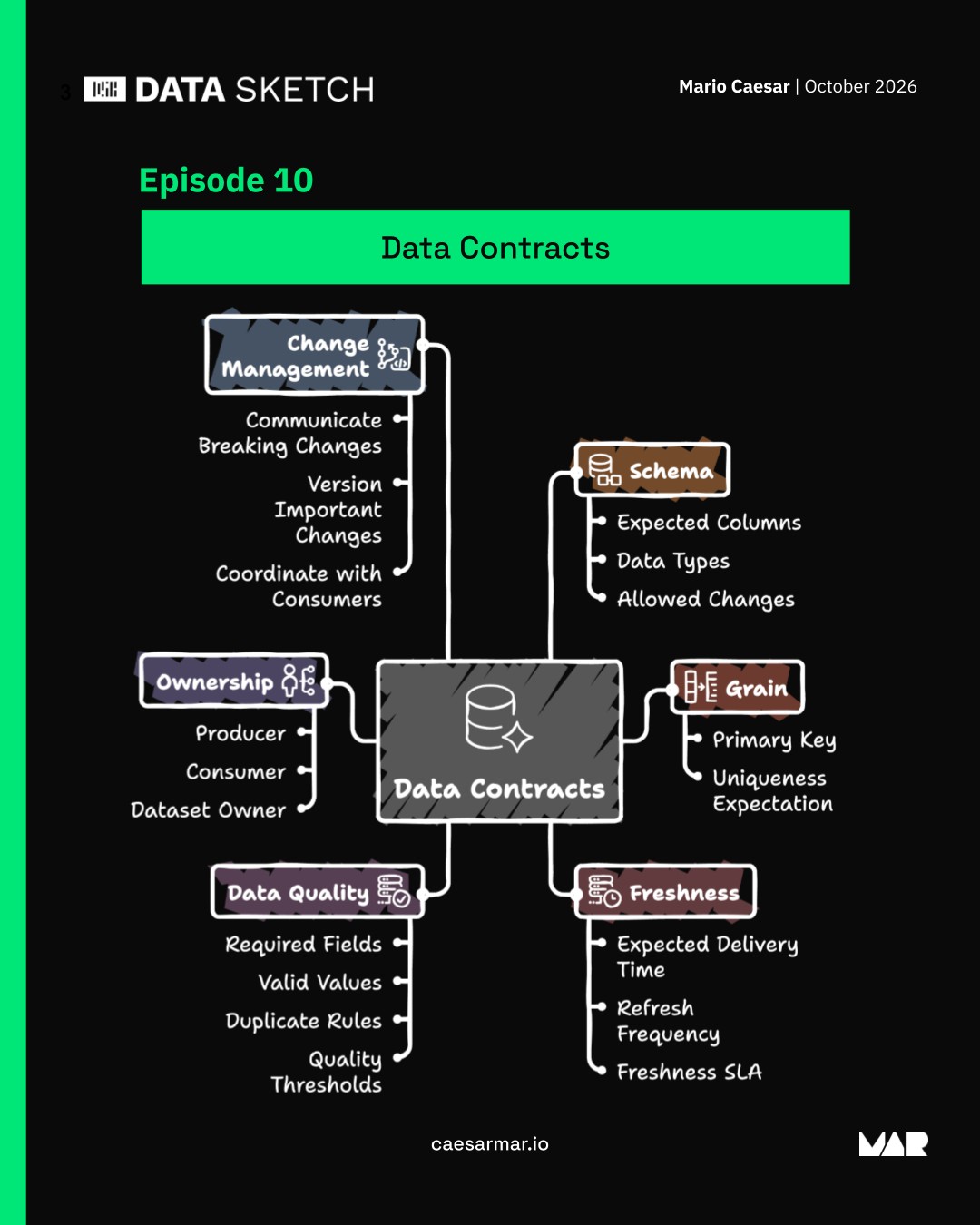
A data contract makes producer and consumer expectations explicit: schema, grain, data quality, freshness, ownership, and how changes are communicated.
[Data Sketch #10] 🤝 Data Contracts: What Should a Pipeline Promise?
Welcome back to Data Sketch. One diagram, one lesson from things I’ve learned in data engineering ✍️
A pipeline can run perfectly and still surprise its downstream users.
❗️ A column suddenly changes type.
❗️A field disappears.
❗️Yesterday’s daily table arrives three hours late.
❗️A supposedly unique key starts producing duplicates.
Nothing necessarily “broke” from the producer’s point of view.
But something changed that the consumer was depending on.
That is where I find the idea of a data contract useful.
👉 A data contract is basically an explicit agreement between the team producing the data and the people or systems consuming it.
❓ What schema should they expect?
❓ What does one row represent?
❓ When should the data arrive?
❓ Which fields must be unique or non-null?
❓ And who owns the dataset when something goes wrong?
For me, the interesting part is not the document itself.
It is making assumptions explicit before they quietly become dependencies.
Because once dashboards, models, or other pipelines depend on a dataset, changing it is no longer just an implementation detail.
It becomes a compatibility problem.
This diagram is the simple way I think about what a useful data contract should actually promise 🤝
Curious: does your team already define contracts between data producers and consumers?
Tags:
#DataEngineering #DataContracts #DataQuality #DataGovernance #DataPipelines #AnalyticsEngineering #DataArchitecture #DataOps
Reading the sketch
Schema and grain
Define expected columns, data types, allowed changes, primary keys, and uniqueness expectations.
Data quality
Agree on required fields, valid values, duplicate rules, and quality thresholds.
Freshness
Set the expected delivery time, refresh frequency, and freshness SLA.
Ownership
Identify the producer, consumer, and dataset owner.
Change management
Communicate breaking changes, version important changes, and coordinate with consumers.